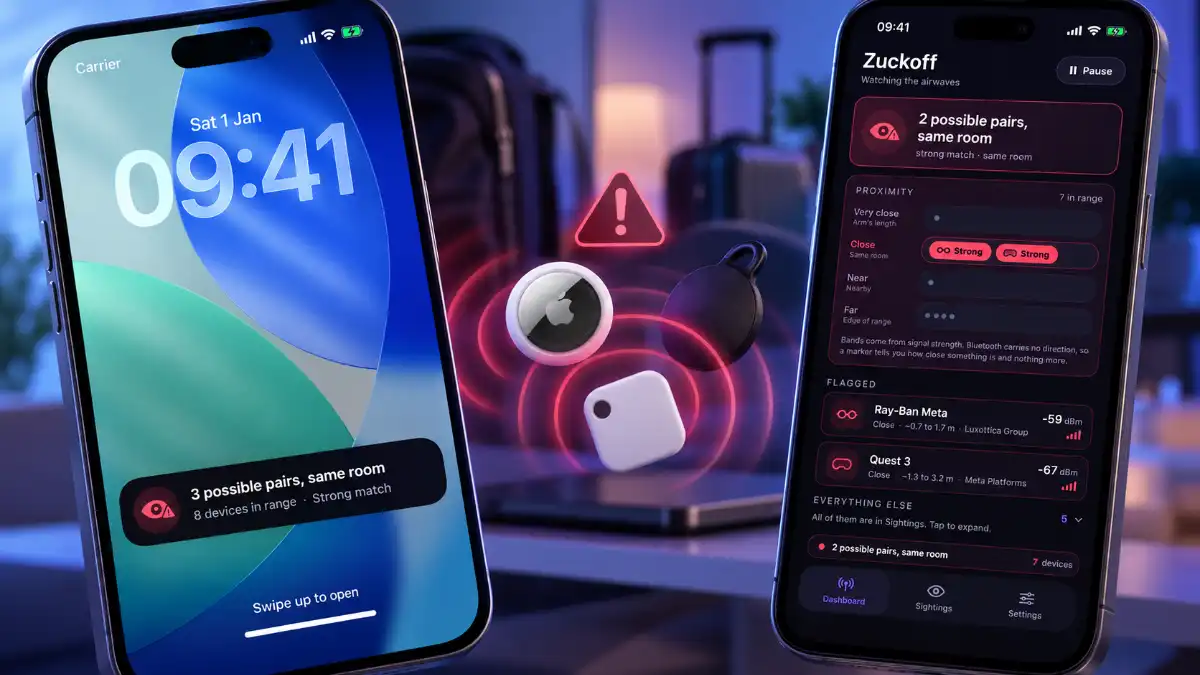
A new iPhone app called Zuckoff is getting attention because it can warn people when certain camera-equipped smart glasses may be nearby. The app looks for Bluetooth signals from supported devices, including Ray-Ban Meta and Oakley Meta glasses, and gives users an estimated distance.
Zuckoff was created by Polish developer Paweł Szydłowski. It has reportedly gained around 5,000 users shortly after its App Store launch, showing that many people are concerned about privacy as smart glasses with built-in cameras become more common.
What Is the Zuckoff App?
Zuckoff is an iPhone app designed to spot Bluetooth broadcasts from supported smart glasses and other wearable devices. Its main purpose is simple: it warns you when a camera-equipped pair of glasses could be close to you.
The app is not a camera blocker, tracking tool, or recording detector. Instead, it acts more like a nearby-device alert system.
When a compatible device sends out a Bluetooth signal, Zuckoff compares that signal with known device information. If it finds a match, the app can show that compatible smart glasses are nearby and provide a rough estimate of their distance.
The name “Zuckoff” is widely seen as a reference to Meta CEO Mark Zuckerberg. The app has become popular because it gives bystanders another way to notice camera glasses that may otherwise be hard to spot.
Which Smart Glasses Can Zuckoff Detect?
Zuckoff is mainly discussed as an app for detecting Meta smart glasses, especially models made with Ray-Ban and Oakley. However, its App Store description says it can recognize more than one type of supported camera wearable.
The app can identify Bluetooth advertisements associated with:
- Ray-Ban Meta smart glasses.
- Oakley Meta smart glasses.
- Snap Spectacles.
- Certain display glasses and headsets in its log.
Some devices, such as Meta Quest headsets and Apple Vision Pro, may appear in the app’s log but are not treated as the same kind of warning because they are large and easy to see.
This is important because Zuckoff does not detect every camera in public. It only works with supported devices that send Bluetooth signals the app recognizes.
How Does Zuckoff Detect Smart Glasses?
Zuckoff uses Bluetooth scanning. Smart glasses can send small Bluetooth advertisements that help phones and other devices identify them, connect to them, or support features such as pairing.
The app scans for these broadcasts and checks details such as device identifiers, UUIDs, and manufacturer information. These details can work like a device fingerprint.
If the fingerprint matches a supported smart-glasses model, Zuckoff shows an alert. It can also estimate how close the glasses may be by measuring Bluetooth signal strength. A stronger signal may mean the device is closer, while a weaker one may mean it is farther away.
However, Bluetooth distance estimates are not exact. Walls, people, bags, metal objects, phone position, and wireless interference can affect the signal. A result should be treated as a rough nearby warning, not an exact location tracker.
Can Zuckoff Tell If Someone Is Recording?
No. This is the most important fact to understand about the Zuckoff app.
Zuckoff cannot see through the glasses, access their camera, view photos or videos, or confirm that a person is recording. It only detects a Bluetooth signal from a supported device.
For example, a person could be wearing Ray-Ban Meta glasses while listening to music, making a call, using voice features, or simply carrying the glasses in a case. The glasses may still send a Bluetooth signal even if the camera is not recording.
Reports say compatible signals can be detected when the glasses are powered on, pairing with a phone, or sitting in their charging case. That means an alert does not automatically mean that someone is filming you.
A more accurate way to describe the app is this:
Zuckoff warns you that supported camera-equipped smart glasses may be close by, but it does not prove that recording is happening.
That distinction matters. The app can raise awareness, but it should not be used to accuse someone of secretly recording without other evidence.
Meta Smart Glasses and the Recording Light
Meta’s camera glasses include a small outward-facing LED light. This light is meant to show people nearby when the wearer is taking photos or recording video.
In theory, the LED helps make recording more visible. If a person starts recording video with Meta smart glasses, people nearby should be able to see the recording indicator on the front of the glasses. Meta has also said its system is designed to stop the camera from working if it detects that the LED has been tampered with.
Still, the light may not always be easy to notice in real life. It can be difficult to see from far away, in bright sunlight, from certain angles, or when people are not looking directly at the glasses.
A recent report involving Germany’s Hamburg privacy regulator said the recording light may be hard for bystanders to notice depending on distance, lighting, and viewing angle. The report also noted differences between glasses generations and AI features.
This is why apps such as Zuckoff are attracting interest. They give users another possible signal that camera-equipped glasses may be present nearby.
Zuckoff Pro and Background Alerts
The standard version of Zuckoff allows users to scan for supported smart glasses around them. But the app also offers a paid Zuckoff Pro version.
According to reports, Zuckoff Pro can monitor in the background and send notifications when it finds compatible smart glasses nearby. This means users may not need to keep the app open all the time.
This type of feature could be useful in places where people may want extra awareness, including:
- Public transport.
- Cafes and restaurants.
- Events and concerts.
- Gyms and fitness centers.
- Schools and college campuses.
- Changing rooms or private spaces, where local rules may apply.
However, an alert alone should be treated calmly and responsibly. A nearby device might belong to someone who is not using its camera at all.
Zuckoff App Limitations
Zuckoff may be useful as a privacy-awareness tool, but it has important limits.
It cannot confirm recording
The app cannot tell if someone is filming, taking a photo, livestreaming, or using only audio features. It only recognizes Bluetooth signals from supported devices.
It cannot identify the wearer
Zuckoff does not tell users who owns the glasses. It cannot give a person’s name, social-media account, phone number, or exact location.
It cannot detect every camera
The app is built for supported smart-glasses signals. It cannot find every hidden camera, smartphone camera, body camera, CCTV camera, or smart glasses model in the world.
Bluetooth results can change
Bluetooth signal strength can be affected by distance, walls, crowd size, bags, furniture, interference, and whether the device is actively broadcasting. A missed alert does not guarantee that no camera-equipped glasses are nearby.
A glasses alert is not proof of wrongdoing
A person wearing Meta smart glasses may not be recording. They could be listening to music, making a call, using navigation, or carrying the glasses in a case.
Why Zuckoff Is Getting Attention
Smart glasses are becoming more useful for hands-free photos, video, calls, AI features, and audio. But built-in cameras also create concerns for people around the wearer.
A smartphone is easy to notice when someone holds it up to record. Smart glasses are different because their camera is placed in an ordinary-looking frame. While Meta includes a recording LED, some people worry that the indicator may be missed in busy or poorly lit places.
Zuckoff does not solve every privacy issue around smart glasses. But it gives iPhone users another way to know that supported camera wearables could be near them.
The app represents a wider debate about privacy, consent, recording indicators, and how technology companies should protect people who did not choose to be part of a recording.
Final Thoughts
Zuckoff is an iPhone app that scans Bluetooth signals to warn users about nearby supported smart glasses, including Ray-Ban Meta and Oakley Meta models. It can provide a rough distance estimate, and its Pro version can reportedly send alerts in the background.
The biggest limitation is simple: Zuckoff cannot prove that someone is recording. It only shows that a compatible camera-equipped device may be nearby.
For now, the app is best used as an extra privacy-awareness tool. It can help users stay informed, but it should never be treated as proof that a person is filming or doing something wrong.