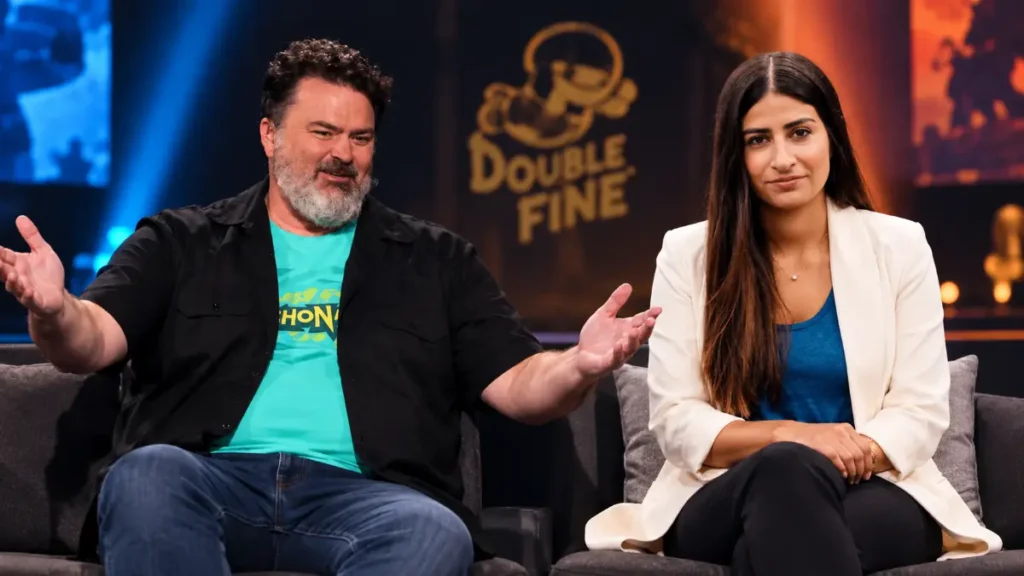
Double Fine founder Tim Schafer has described the studio’s move away from Xbox as a “creative awakening.” The Psychonauts developer became independent again in 2026 after spending around seven years under Microsoft’s Xbox Game Studios label.
The change has not been easy. Double Fine had to reduce its team by 23 people after becoming independent. Still, Schafer believes the studio is rediscovering something important: the freedom to shape its own future, choose its own projects, and build games in its own unusual style.
Schafer also explained that Double Fine and Xbox worked well together for a long time. However, Xbox later changed its priorities, making it harder for a smaller creative studio like Double Fine to remain part of the company.
Tim Schafer Calls Double Fine’s Xbox Exit a Creative Awakening
Tim Schafer is one of the most well-known names in game development. He helped create classic games such as Grim Fandango, Day of the Tentacle, and Psychonauts. His studio, Double Fine, is loved for making strange, funny, imaginative, and story-driven games.
After Double Fine left Xbox, Schafer admitted that the process was stressful. The team faced difficult talks, major business decisions, and uncertainty about what would happen next.
But he also said the experience has brought fresh energy to the studio.
“Some people said: ‘I’m checking out, this is one too many battles for me.’ But for the rest of us, it’s like a creative awakening.”
For Schafer, independence means Double Fine can once again solve creative problems in its own way. The studio now has to think carefully about budgets, publishers, game ideas, and how to reach players. That is challenging, but it also gives the team more control.
Instead of only making games that fit into a larger Xbox strategy, Double Fine can focus on projects that match its own identity.
Why Did Double Fine Leave Xbox?
Double Fine joined Xbox Game Studios in 2019. At the time, the deal made sense for both sides.
Microsoft gave Double Fine more financial support and stability. In return, Double Fine could make creative games for Xbox players and Game Pass subscribers. Game Pass was especially important because it allowed players to try new games without paying full price for every title.
This was useful for studios that make unusual games.
A player may be unsure about buying a strange, artistic, or experimental game at launch. But if that game is included with Game Pass, they may decide to try it. This can help smaller games find a bigger audience.
Schafer said Xbox and Double Fine originally shared a clear goal:
“We had a mutually beneficial mission, which is just to put great games on Game Pass, and then their mission changed.”
This quote explains the main reason behind the split.
Double Fine was not necessarily unhappy with Xbox at the beginning. Instead, Xbox’s business plans changed over time. As Microsoft focused more on restructuring, efficiency, and different long-term goals, Double Fine may no longer have fit the company’s new direction in the same way.
Xbox’s Changing Priorities Affected Double Fine
Game studios often depend on the goals of the companies that own them. When those goals change, even talented teams can be affected.
Double Fine is not known for making the same type of games as huge annual franchises. Its games are often colorful, creative, humorous, and built around unique ideas. Examples include:
- Psychonauts 2, a platform game about young psychic agents
- Brütal Legend, an action adventure game inspired by heavy metal music
- Costume Quest, a funny role-playing game with Halloween themes
- Broken Age, a story-focused point-and-click adventure
- Keeper and Kiln, newer games that continued Double Fine’s creative style
These kinds of games can earn strong reviews and build loyal communities. However, they may not always produce the same massive sales numbers as a major multiplayer shooter, sports game, or open-world blockbuster.
Schafer suggested that Double Fine’s future at Xbox was probably not based only on whether a game made money.
Tim Schafer Says a Big Hit May Not Have Saved Double Fine
One of Schafer’s strongest comments was about whether Double Fine could have done anything differently to stay with Xbox.
He said:
“I can’t imagine any amount of profitability unless we had a breakout, Minecraft hit that year would’ve saved us.”
This does not mean Double Fine wanted to make games that lost money. Schafer has said that the studio did not set out to create games that would fail financially.
Instead, he appears to be saying that the decision was bigger than a single game’s sales.
Even if Double Fine had a successful release, Xbox’s wider change in priorities may still have led to the studio becoming independent. A smaller studio with a different type of output may not have matched the future Xbox wanted to build.
The mention of Minecraft is important. Minecraft became one of the biggest games in history, with huge sales, long-term player support, and a massive global audience. Schafer’s point was that Double Fine may have needed an extremely rare, giant success to change the situation.
Double Fine Is Independent Again
Double Fine is now an independent company again. This gives the studio more freedom, but it also brings more responsibility.
As an independent developer, Double Fine must manage its own budget, plan its game releases, find publishing partners when needed, and decide how large its projects can be.
The studio has also regained, or is in the process of regaining, intellectual property and publishing rights for its games made during the Xbox era. This is a major change because it gives Double Fine more control over its catalogue.
That includes important games and series connected to the studio’s history, such as Psychonauts, Brütal Legend, Costume Quest, and other Double Fine projects.
In simple terms, this means Double Fine can have more control over how its games are sold, promoted, updated, rereleased, or brought to new platforms.
However, Schafer noted that some changes may take time to fully process. Rights transfers, store listings, publishing details, and other business work do not happen overnight.
Double Fine Laid Off 23 Employees
The move to independence came with a painful cost.
In July 2026, Double Fine confirmed it had let go of 23 employees. Schafer said the decision was made because the studio needed to become a size it could afford as an independent company.
He explained that the layoffs were not taken lightly. Double Fine described itself as a close team and said the people leaving had made important contributions to the company’s games and culture.
This is an important part of the story. While independence has given Double Fine new creative freedom, it has also meant difficult decisions. Smaller studios have fewer financial protections than large companies, so they must carefully match their team size to their expected income and future projects.
Tim Schafer’s Joke About Xbox CEO Asha Sharma
Schafer does not seem to view the split as a personal fight with Xbox CEO Asha Sharma.
During his comments, Schafer made a dark joke:
“Asha’s not going to shoot my dog.”
He followed this by saying that no one could put Double Fine out of business except him. The joke was strange, but the message behind it was clear: Schafer believes the studio’s future is now in Double Fine’s own hands.
He is not blaming one person at Xbox for everything that happened.
Instead, he sees the separation as a business decision caused by changing priorities. The studio now needs to prove that it can survive and grow independently.
That attitude may help explain why Schafer is speaking positively about the future, even after a difficult year.
What Could Double Fine Make Next?
Double Fine has not fully revealed every project it plans to make after leaving Xbox. However, the studio has already shown signs that it wants to return to its creative roots.
One major example is the return of Amnesia Fortnight. This is Double Fine’s famous internal game-jam event where developers form small teams and build new game ideas in a short time.
These small prototypes can lead to bigger projects later. The event is a good fit for Double Fine because the studio is known for taking creative risks and trying unusual concepts.
The company has also discussed using different ways to support future projects. This could include:
- New publishing partnerships
- Game ports for more platforms
- Remasters or rereleases of older games
- Sales from its existing game catalogue
- Crowdfunding or community-backed projects
- Smaller games with more focused budgets
This does not guarantee a new Psychonauts game or a Brütal Legend 2. However, Double Fine having more control over its own IP gives fans more reason to hope that its older series could return in the future.
What Leaving Xbox Means for Double Fine Fans
For fans, Double Fine becoming independent again has both positive and uncertain parts.
The positive side is that the studio may have more freedom to make the kind of weird, creative games that made it famous. Schafer and his team do not need to follow the exact direction of a larger company.
The uncertain side is funding. Big games cost a lot of money to make. Double Fine will need to choose projects carefully and avoid taking risks that could hurt the studio’s long-term future.
Still, Schafer’s “creative awakening” comment shows that the team is not giving up. The studio appears ready to build a new chapter around independence, ownership, and creative control.
Final Thoughts
Tim Schafer’s comments show that Double Fine’s split from Xbox was not simply about personal conflict or one game failing. Xbox and Double Fine once had a shared Game Pass mission, but Xbox’s priorities changed over time.
Schafer believes that even strong profits may not have been enough to keep Double Fine inside Xbox unless the studio had created a massive hit on the level of Minecraft.
Now, Double Fine faces a harder road as an independent developer. It has a smaller team, more financial responsibility, and major choices ahead. But it also has something valuable: the chance to control its future and make games in its own creative style.
For a studio built on imagination, humor, and unusual ideas, that freedom could be the beginning of an exciting new era.