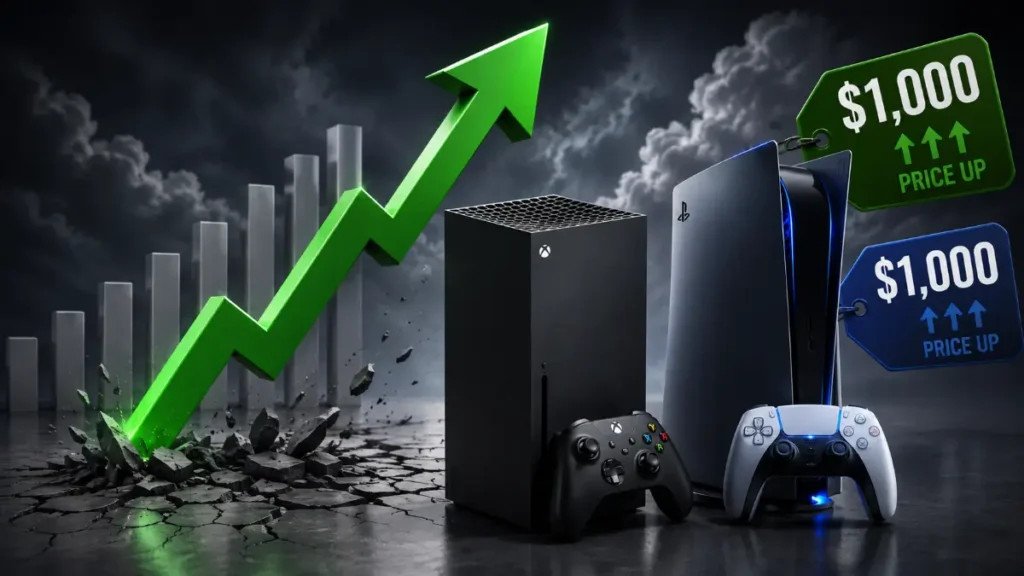
A new market forecast says Sony and Microsoft could face a major problem if the PS6 and Xbox Project Helix launch at $1,000. Ampere Analysis estimates that high prices could cut the two consoles’ combined first-five-year sales by as much as 38% compared with PS5 and Xbox Series X|S sales over the same period.
The important word is could. Neither Sony nor Microsoft has officially announced the PS6 price, Xbox Project Helix price, or a 2028 launch date. This is a scenario forecast, not a confirmed plan.
A new analysis from Ampere Analysis looks at what may happen if Sony and Microsoft release traditionally designed next-generation consoles in 2028 and charge $1,000 for each system.
According to the forecast, players may be far less willing to upgrade at that price. The report predicts that PS6 and Xbox Project Helix sales could be up to 38% lower during their first five years than the combined sales of the PS5 and Xbox Series X|S during the equivalent period.
That is close to a 40% sales drop.
For many players, $1,000 is not just the price of a console. It is the starting point. A new system may also require games, extra storage, a second controller, a headset, online membership, or even a newer TV to get the best experience. Those extra costs can quickly make the jump to a new console feel too expensive.
A player choosing between a $1,000 console and continuing to use a PS5, Xbox Series X, gaming PC, or handheld device may decide there is no rush to upgrade.
PS6 and Xbox Helix Are Not Officially Priced
It is important to separate confirmed facts from predictions.
Sony has not announced the PS6’s release date or price. Sony CEO Hiroki Totoki recently said that the company had not decided when to launch its next console or what price it would carry.
Microsoft has also not fully revealed its next Xbox hardware. “Project Helix” is a reported working name for the company’s next-generation Xbox system, rather than a confirmed retail name. Reports have suggested the machine could have strong PC-like features, but Microsoft has not announced final specifications, launch timing, or pricing.
So, readers should not treat $1,000 as the confirmed price of the PS6 or next Xbox. It is an analyst’s warning about what might happen if both companies choose that price point.
A new analysis says a $1,000 launch price for the PS6 and Xbox Project Helix could seriously hurt sales.
Ampere Analysis estimates that if both consoles launch at $1,000 in 2028, they could sell nearly 40% fewer units over their first five years compared with the PS5 and Xbox… pic.twitter.com/ySKdQ8OxNi
Console makers do not only make money when a person buys the hardware. They also earn money when players buy games, downloadable content, subscriptions, accessories, and other services.
If fewer people buy a PS6 or Project Helix, fewer people enter the new console ecosystem. That can affect game sales, PlayStation Plus subscriptions, Xbox Game Pass memberships, microtransactions, and third-party publisher sales.
Ampere Analysis estimates that the PlayStation and Xbox console games-and-services market could be $3.4 billion smaller by 2031 in a $1,000 launch-price scenario than it would be if both consoles launched at $700. That would be a 12% decline in the combined market.
In simple terms: a higher console price may give companies more money per hardware sale, but it could also mean millions of players wait longer, buy cheaper devices, or skip the generation completely.
The $700 Alternative
Ampere’s comparison uses a $700 launch price as the lower-price scenario. That is still expensive compared with many past console launches, but it would be much easier to accept than $1,000 for many households.
A $700 system would not automatically guarantee a successful console generation. Players will still care about exclusive games, performance, backward compatibility, storage, subscriptions, and whether their current console still plays new releases well.
However, the analysis suggests that price remains one of the biggest barriers to adoption.
Launch-price scenario
Expected impact
$700 launch price
Larger potential audience and stronger spending across games and services
$1,000 launch price
Up to 38% fewer combined console sales over five years
$1,000 launch price
PlayStation and Xbox games-and-services market potentially $3.4 billion smaller by 2031
The industry has already seen how quickly console prices can become difficult for players. Recent Xbox price increases pushed some current models close to premium-PC territory in certain markets, making value more important than ever for the next generation.
Sony and Microsoft may have several ways to avoid putting a $1,000 price tag on standard PS6 and Xbox Project Helix models.
One choice would be to offer more than one version at launch. A lower-cost digital edition could help get players into the ecosystem, while a stronger or larger-storage premium model could target enthusiasts.
Another option would be for console makers to accept lower profits on hardware early in the generation. This has happened before in the console business, where companies earn back money later through game sales, subscriptions, and digital store purchases.
They could also control costs by choosing hardware that delivers a noticeable leap over PS5 and Xbox Series X|S without making every part of the system as expensive as possible.
What This Means for Players
The $1,000 PS6 and Xbox Project Helix forecast is not a prediction that the consoles will fail. It is a reminder that next-gen hardware needs a clear reason for players to upgrade.
Players may pay premium prices if a console offers major improvements, must-play games, useful features, and a strong long-term library. But if the new systems feel like smaller upgrades over current hardware, a four-figure price could make waiting the smarter choice.
For now, the PS6’s price, release window, and hardware remain unconfirmed, and the same is true for Microsoft’s Project Helix. Still, Ampere Analysis’ forecast shows why Sony and Microsoft will need to balance power, features, and affordability carefully as the next console generation approaches.