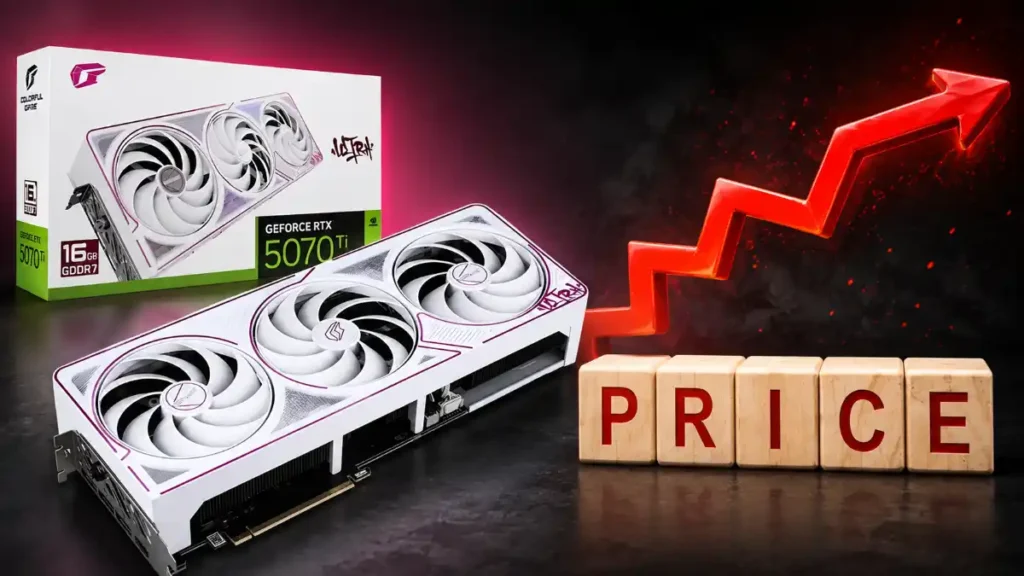
Gamers watching the latest hardware market just got another reminder that high-end graphics cards do not stay cheap for long. Fresh reports show MSI and Colorful have pushed through notable RTX 50 price hikes across nearly their entire lineup in China. The jumps tie directly to climbing GDDR6 and GDDR7 memory costs plus higher GPU kit prices that NVIDIA is passing along to board partners. The biggest standout so far is the RTX 5070 Ti, where some listings now sit 38 percent above NVIDIA’s original MSRP, and certain Colorful models climb even higher.
These changes are not isolated to one card or one brand. Distributor sheets for both companies list increases that range from the mid-teens into the low twenties for most models, with a few outliers stretching further. The pattern points to structural cost pressure rather than temporary supply hiccups, and that has the potential to ripple beyond China if the same memory and kit costs keep rising.
MSI and Colorful both updated their pricing lists for partners, and the numbers show clear upward movement across the RTX 50 series. The RTX 5090 sits up to 16 percent higher. The RTX 5080 lands around 20 percent higher. The RTX 5070 Ti shows increases of up to 20 percent in many cases, though some models start at 38 percent above MSRP. The RTX 5070 itself is listed as much as 15 percent higher.
MSI’s revised sheet places many cards roughly 10 to 20 percent above the prices from the prior week. Colorful’s lists push some models well above MSRP, especially on the higher-end cards. These are distributor-level figures, so the final street prices gamers see can still vary by retailer, region, and specific model, but the direction is consistent: almost the whole lineup is moving up.
Why RTX 50 Prices Are Climbing Right Now
The core driver behind these RTX 50 price hikes is memory. Sources report that both GDDR6 and GDDR7 have become more expensive, and NVIDIA has notified its add-in board partners of kit price increases tied to memory and GPU procurement costs.
One detailed account puts the average rise for GDDR6 and GDDR7 at about 19 to 20 dollars. NVIDIA’s partner update also included surcharges scaled by VRAM capacity: roughly 90 dollars for 8 GB cards, 130 dollars for 12 GB cards, and 175 dollars for 16 GB cards. When board partners absorb those higher input costs, they adjust the prices they charge distributors. That adjustment is exactly what MSI and Colorful have done.
Because memory sits at the heart of every modern graphics card, a broad rise in GDDR pricing tends to affect the entire stack rather than just one SKU. That helps explain why the increases appear across the 5090, 5080, 5070 Ti, and 5070 rather than being limited to a single model.
Reported NVIDIA GPU Kit Price Increases
VRAM Capacity
Estimated Kit Price Increase
8 GB
US$90
12 GB
US$130
16 GB
US$175
How Large the Increases Really Are
Headline percentage jumps of 15 to 20 percent already look steep, yet some market-wide snapshots in China paint an even sharper picture. One report puts the average RTX 5080 price about 47.7 percent above MSRP. The RTX 5070 Ti sits around 46.5 percent above MSRP on average, and the RTX 5070 lands near 38.5 percent above MSRP, depending on the exact model and brand.
Colorful cards in particular can reach as high as 60 percent above MSRP on certain configurations. MSI’s week-over-week movement is more modest by comparison, topping out around 20 percent above the previous week’s figures. The gap between official MSRP and real-world distributor pricing has clearly widened, and the latest adjustments only push that gap further.
Specific Model Price Examples from the New Lists
Concrete examples make the scale easier to grasp. On the MSI side, the RTX 5080 Shadow 3X OC and Ventus models moved from 9,999 yuan to 11,999 yuan, a clean 20 percent rise. The RTX 5080 Gaming Trio OC climbed from 10,999 yuan to 12,999 yuan, an 18.2 percent increase. The RTX 5070 Ti Gaming Trio OC went from 8,199 yuan to 9,699 yuan, up 18.3 percent. The RTX 5070 Ti Shadow 3X OC rose from 7,699 yuan to 9,199 yuan, a 19.5 percent jump.
Colorful’s distributor sheet shows similar pressure. The RTX 5080 Vulcan W OC appears at 13,200 yuan, and other RTX 5070 Ti and RTX 5070 variants sit at higher tiers than they did before. These figures are not final retail prices, but they set the floor that downstream sellers will work from. When distributors pay more, the cards that eventually reach store shelves and online listings tend to follow.
MSI Price Comparison
Graphics Card
Previous Price
New Price
Increase
RTX 5080 Shadow 3X OC
9,999 yuan
11,999 yuan
20.0%
RTX 5080 Ventus
9,999 yuan
11,999 yuan
20.0%
RTX 5080 Gaming Trio OC
10,999 yuan
12,999 yuan
18.2%
RTX 5070 Ti Gaming Trio OC
8,199 yuan
9,699 yuan
18.3%
RTX 5070 Ti Shadow 3X OC
7,699 yuan
9,199 yuan
19.5
What These Price Moves Mean for Gamers
The short version is straightforward: the RTX 50 series is getting more expensive in China first. The underlying causes look structural rather than temporary. Memory costs and GPU kit costs are moving higher, so board partners are adjusting distributor pricing across nearly the entire range. If those cost pressures continue, other partners and other regions could see similar adjustments.
Expect RTX 50 GPUs to remain above launch MSRP for the foreseeable future.
Memory prices continue to put pressure on graphics card manufacturing costs.
Future discounts may be smaller than many buyers expect.
Additional global price increases remain possible if GDDR costs continue rising.
Comparing prices across retailers will be more important than ever before upgrading.
For buyers, the practical takeaway is that waiting for prices to settle closer to original MSRP may not be a safe assumption right now. The cards that already sit well above recommended pricing are likely to stay elevated until memory markets cool or NVIDIA revises its kit pricing downward. Shoppers who need a new card soon may want to compare current listings carefully against the new distributor levels and factor in the possibility of further movement.
Enthusiasts who follow launch cycles know that early premium pricing is common, but sustained increases driven by component costs feel different. The RTX 50 series already faced higher-than-expected street prices in many markets after launch. These latest distributor hikes in China add another layer of upward pressure and suggest the cost environment for high-bandwidth memory remains tight.
Looking Ahead at the Broader Market
Because the reported driver is memory pricing that affects the whole product stack, the pattern is unlikely to stay confined to one country forever. Board partners operate on thin margins when card prices sit close to MSRP, so any sustained rise in input costs eventually shows up in the prices they charge. China simply appears to be the first major market where MSI and Colorful have formally updated their sheets.
Gamers watching global pricing should keep an eye on whether other regions begin reflecting the same kit and memory surcharges. If they do, the gap between official MSRP and actual purchase prices could widen further across the RTX 50 lineup. For now, the clearest signal is the one coming out of China: nearly every card from the RTX 5070 upward has become more expensive at the distributor level, with the RTX 5070 Ti showing some of the steepest relative jumps.
The situation remains fluid. Memory markets can shift, and board partners sometimes absorb costs temporarily to protect volume. At the moment, however, the data points to higher prices rather than relief. Anyone planning a new build or upgrade should treat the latest distributor figures as a realistic baseline rather than an outlier and plan budgets accordingly.
Hi there! I'm Khalid, your go-to guy for all things gaming, anime, and digital content. I'm a seasoned writer and blogger specializing in crafting engaging narratives and generating eye-catching images and media for these vibrant worlds.When I'm not immersed in virtual adventures or conjuring up captivating visuals, you'll likely find me enjoying the company of fellow enthusiasts.